
EXPLORE OUR REGION
The Caribbean Cultural Atlas.
A living map of our people, places, rhythms, traditions and creativity.
From the islands to the mainland Caribbean, discover the cultural connections that make our region extraordinary.
EXPLORE THE CARIBBEAN / CULTURAL MAP
A region of living culture.
Explore the Caribbean map, then choose a country to discover its music, visual arts, history, festivals and creative voices. Map locations and cultural profiles are separate: traditions belong to communities, while galleries, venues and institutions can be pinned to precise places.
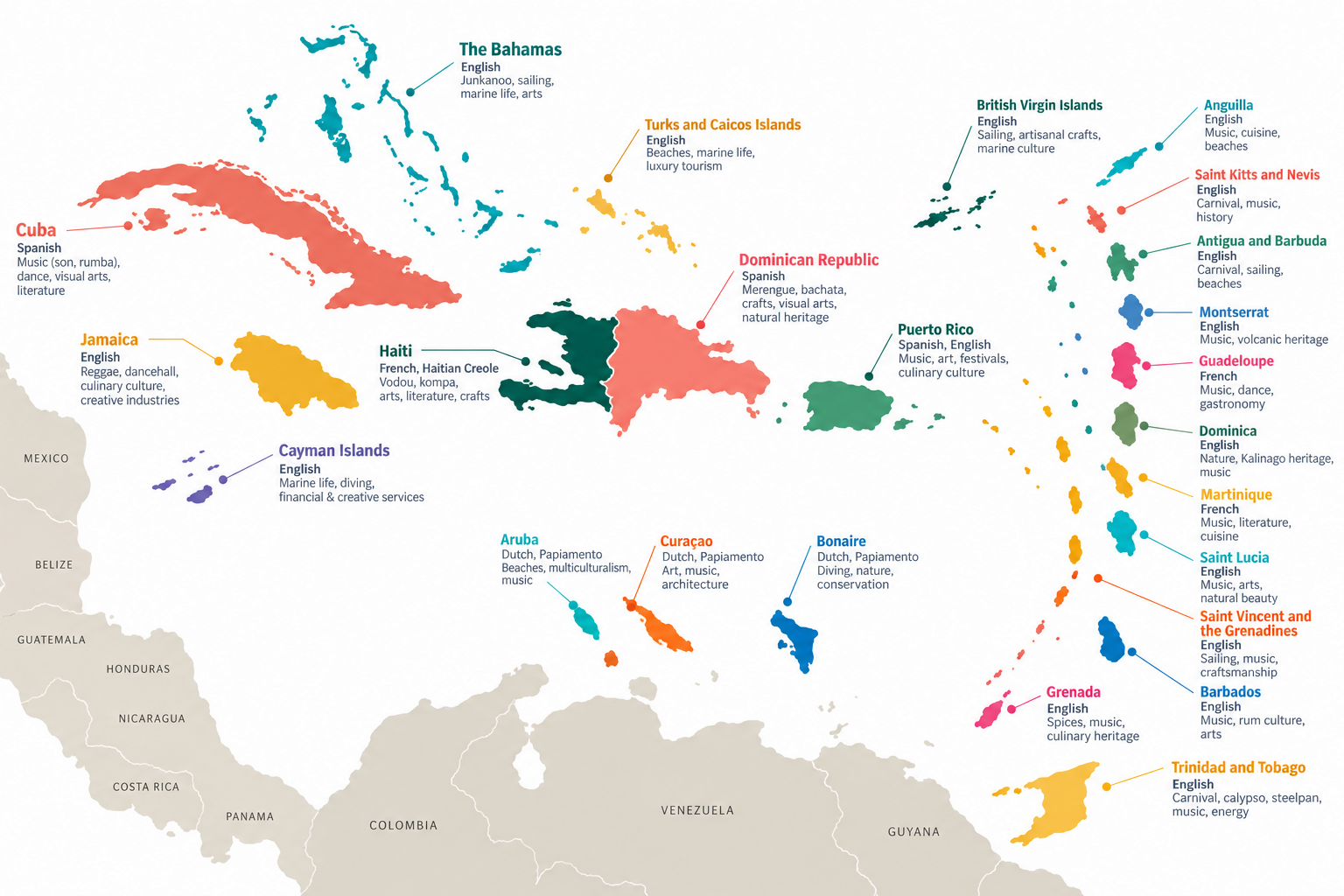
Explore the illustrated regional overview, then choose a country below to jump to its cultural profile. This visual is a preliminary concept, not a geographically authoritative map.
THE CARIBBEAN / COUNTRIES & TERRITORIES
Many places. One connected region.
Explore flags from across the insular and mainland Caribbean. The directory includes sovereign countries and non-sovereign territories; some territories share national flags, while others have distinct local symbols.
🇻🇨 Saint Vincent and the Grenadines
🇦🇮 Anguilla
🇦🇼 Aruba
🇧🇶 Bonaire
🇨🇼 Curaçao
🇬🇵 Guadeloupe
🇲🇶 Martinique
🇲🇸 Montserrat
Regional scope is intentionally inclusive rather than a list of sovereign states only. Flag emoji appearance varies by device; Bonaire and Saint Martin may display a shared or substitute flag on some platforms.
OUR SHARED PAST
A brief history of the Caribbean.
Long before European arrival, the Caribbean was home to diverse Indigenous peoples, including Taíno, Kalinago and other communities, whose cultures, knowledge and legacies remain part of the region today.
From the late fifteenth century, European colonization transformed the islands and surrounding mainland. Plantation economies relied on the forced labor of enslaved Africans, while Indigenous and African communities resisted dispossession and oppression. The Haitian Revolution, culminating in independence in 1804, became a defining moment in the struggle against slavery and colonial rule.
Emancipation, migration, indentured labor and movements for independence shaped the Caribbean of today. Indigenous, African, European, Indian, Chinese and other influences helped form its many languages, spiritual practices, cuisines, artistic traditions and musical genres. The region includes independent nations and territories with different political relationships—and a remarkable shared cultural history.
Our story is not one history, but many interconnected histories.
FOUR WAYS TO EXPLORE
Follow your curiosity.
Every island has a story. Every tradition has a place. Where will you begin?
CACULCO ATLAS / 01
♫
Music & Dance
Explore the rhythms, genres and movements that connect the Caribbean.
CACULCO ATLAS / 02
✦
Artists & Organizations
Meet the creative voices, institutions and communities shaping our culture.
CACULCO ATLAS / 03
◈
Heritage & Traditions
Discover living histories, festivals, craftsmanship and cultural memory.
CACULCO ATLAS / 04
✳
Food & Experiences
Taste the stories, ingredients and experiences that bring us together.
START EXPLORING / SIX CULTURAL SPOTLIGHTS
Discover the Caribbean, one culture at a time.
From iconic sounds to living traditions, these six introductions offer a glimpse into the region’s extraordinary cultural diversity.
HAITI · MUSIC
Kompa
A Haitian popular music genre that emerged in the 1950s, celebrated for its danceable rhythms.
JAMAICA · MUSIC
Reggae
A Jamaican music tradition known worldwide for its distinctive rhythm and powerful social messages.
TRINIDAD & TOBAGO · MUSIC
Steelpan
The melodic steel instrument developed in Trinidad and Tobago, now heard across the world.
HAITI · HERITAGE
Rara
A vibrant Haitian processional tradition blending music, movement and community expression.
TRINIDAD & TOBAGO · FESTIVALS
Trinidad Carnival
A major celebration of masquerade, music and creativity with deep historical roots.
CUBA · HERITAGE
Cuban rumba
An Afro-Cuban tradition of music, dance and communal expression.
These are introductory cultural spotlights, not geocoded map entries. Each tradition extends beyond a single point on a map.
Help us map Caribbean culture.
Are you an artist, cultural organization, researcher or community leader? We want to hear from you as we build the atlas.

